
Camera inspection: $300–$750
The first and non-negotiable step. Most operators credit it against the works if you proceed.
We camera the line first, show you what is actually wrong, and then tell you whether relining is the right answer. Often it is. Where the pipe has collapsed or lost its fall, it is not, and we will say so rather than sell you a liner that disappoints.
The failure that brings most people here is not a broken pipe. It is a joint. Older drainage is laid in short lengths, so a single run has a great many joints, and after decades of ground movement and root pressure they open a fraction at a time until something backs up.
A liner seals all of them in one pass, which is why it changes the pattern rather than resetting it. Cutting roots out clears the pipe and leaves the way in exactly as it was, and the interval to the next blockage is set by how fast they grow back.
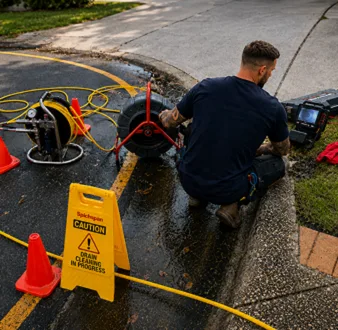
A food premises line narrows with hardened fat long before it fails structurally. Relining a greased line without addressing the grease simply gives you a smooth new surface to coat, and the interval to the next problem barely changes.
The right sequence is jet it clean, camera it properly, and then decide. If the barrel is sound the answer may be a service schedule rather than a liner. Where the camera shows cracks or open joints under the build-up, relining is worth doing and the smoother bore genuinely slows re-accumulation.
Ground falling toward the Georges River leaves lower properties prone to stormwater backups in heavy rain. We clear the blockage and restore flow.
Ground near water holds more of it, sits lower and moves more through the seasons than ground further up. Pipework laid decades ago has been flexed by that movement for its whole life, and joints open a fraction at a time rather than failing all at once.
It is why faults here tend to arrive as a slow decline rather than a sudden break, and why a camera often finds a run that is uniformly tired instead of one obvious defect. That pattern suits a full-length liner rather than a patch.
Properties on a slope often have long drainage runs, sometimes crossing the whole block to reach the main. The practical questions are where the inspection openings are and whether the liner can be drawn through in one length or needs a second access.
That is worth establishing before quoting. A single long run costs less per metre than the same distance broken into stages, and the difference is decided by access, not by the pipe.
Much of Revesby’s housing dates to the postwar boom and still runs original earthenware that cracks, sags and lets roots in. CCTV locates the fault.
Clay is rigid, round and predictable, and that geometry is exactly what a liner wants. The resin sleeve cures hard against a barrel that holds its shape, and the short pipe lengths that make clay joint-heavy are the same joints the liner seals in one pass.
So the material that causes the most recurring blockages in older streets is also the easiest to repair properly without digging. That is a genuinely lucky combination and it is why relining suits this housing stock so well.
In a strip of tenancies the drainage is frequently shared, which means the fault is often not under the premises reporting it, and the party who pays is not always the party who called.
That is worth settling before the quote rather than after. Camera footage with distances marked from a known access point is what makes the conversation with a landlord or a neighbouring tenant short, because it shows exactly where the defect sits.
Excavation close to the foreshore brings problems that have nothing to do with plumbing: unstable saturated ground, dewatering, restricted access down a narrow lot, and reinstatement of landscaping that was not cheap to build.
The trenchless comparison is not repair against repair. It is repair against repair plus everything sitting on top, and on a waterfront block that second half is usually the bigger number.
The first and non-negotiable step. Most operators credit it against the works if you proceed.
Domestic sewer across Sydney in 2026. Longer single runs sit at the lower end of it.
Seals one defect. Right where the rest of the run is sound and the ground is stable.
Length, diameter and how many branches need reinstating are what move the number inside that band.
Excavation is only half the cost. Replacing the driveway or garden above it is the other half.
These are market ranges, not our price. Nothing is quoted before the survey, and nothing starts before you agree it. Figures here are indicative of the 2026 Sydney market rather than a quote from us, you get your own number as a fixed price before any work starts.

Nothing is priced until a camera has been down the line. The survey is recorded, distances are marked from a known point, and the footage is yours.
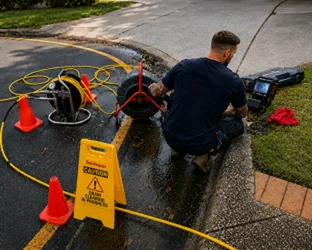
A single defect in a sound run wants a patch. A run failing along its length wants a full liner. A collapsed or sagging section wants excavation. The camera decides, not the quote.
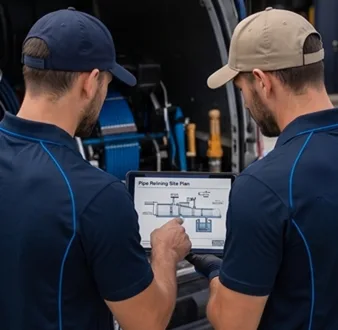
Jet clean, install through the existing opening, cure in place. Water is off for part of the day and nothing above the pipe is disturbed.

Junctions reinstated, final camera run, and the compliance paperwork where the work is notifiable. You keep both recordings.
Describe what the drain is doing and how often. We will tell you whether it sounds structural or whether a clean and a maintenance interval is the honest answer.
Cost, lifespan, method, and the cases where a liner is the wrong answer.
Phone is quickest. The form reaches the crew covering Revesby, and the first step is always the survey.

Leave your details and our local Revesby team will call you back fast.